
Blockchain-Secured LLMs: The Future of Trustworthy AI
Large Language Models (LLMs) like GPT-4, Claude, and Gemini have revolutionized artificial intelligence, enabling breakthroughs in natural language processing, content generation, and decision-making.
However, their centralized nature raises concerns about data privacy, model integrity, censorship, and bias. Blockchain technology offers a decentralized, transparent, and tamper-proof framework to address these challenges.
By integrating blockchain with LLMs, we can create auditable, censorship-resistant, and user-controlled AI systems. This article explores how blockchain enhances LLM security, key use cases, challenges, and the future of decentralized AI.
The Trust Deficit in Traditional LLMs
Centralized Control & Risks
Most LLMs are controlled by a single entity (e.g., OpenAI, Google), leading to:
- Data Privacy Risks: User inputs stored on centralized servers are vulnerable to breaches.
- Model Manipulation: Proprietary models can be silently altered, introducing bias or censorship.
- Lack of Transparency: Closed-source models make it impossible to audit training data or decision-making processes.
- Censorship & Restrictions: Corporations and governments can enforce content filters, limiting free expression.
Real-World Incidents
- Microsoft's Tay AI (2016) – Quickly manipulated into generating offensive content due to centralized training.
- ChatGPT's "Woke" Bias (2023) – Users demonstrated political bias in responses due to undisclosed filtering.
- Data Leaks (2024) – AI companies like DeepMind faced scrutiny over training data sources.
Solution: Blockchain introduces decentralization, cryptographic security, and verifiable transparency to mitigate these risks.
How Blockchain Enhances LLM Trust & Transparency
Decentralized Model Training
- Federated Learning + Blockchain: Models train across distributed nodes without exposing raw data (e.g., NVIDIA's Federated Learning).
- Auditable Data Provenance: Blockchain logs training data sources, ensuring compliance (e.g., EU AI Act).
Immutable Model Weights & Updates
- Smart Contracts for Model Governance: Changes to LLM parameters require DAO voting (e.g., Bittensor's decentralized AI network).
- Proof-of-Training (PoT): Miners validate training processes, preventing tampering.
Transparent Content Verification
- Zero-Knowledge Proofs (ZKPs): Verify AI-generated content without exposing sensitive data (e.g., Worldcoin's Proof-of-Personhood).
- NFT-Based Content Signing: AI outputs are cryptographically signed to prevent deepfakes.
User-Controlled Data & Monetization
- Self-Sovereign Identity (SSI): Users own their data via blockchain IDs (e.g., Microsoft's ION on Bitcoin).
- Data Marketplaces: Users sell anonymized data for AI training via Ocean Protocol.
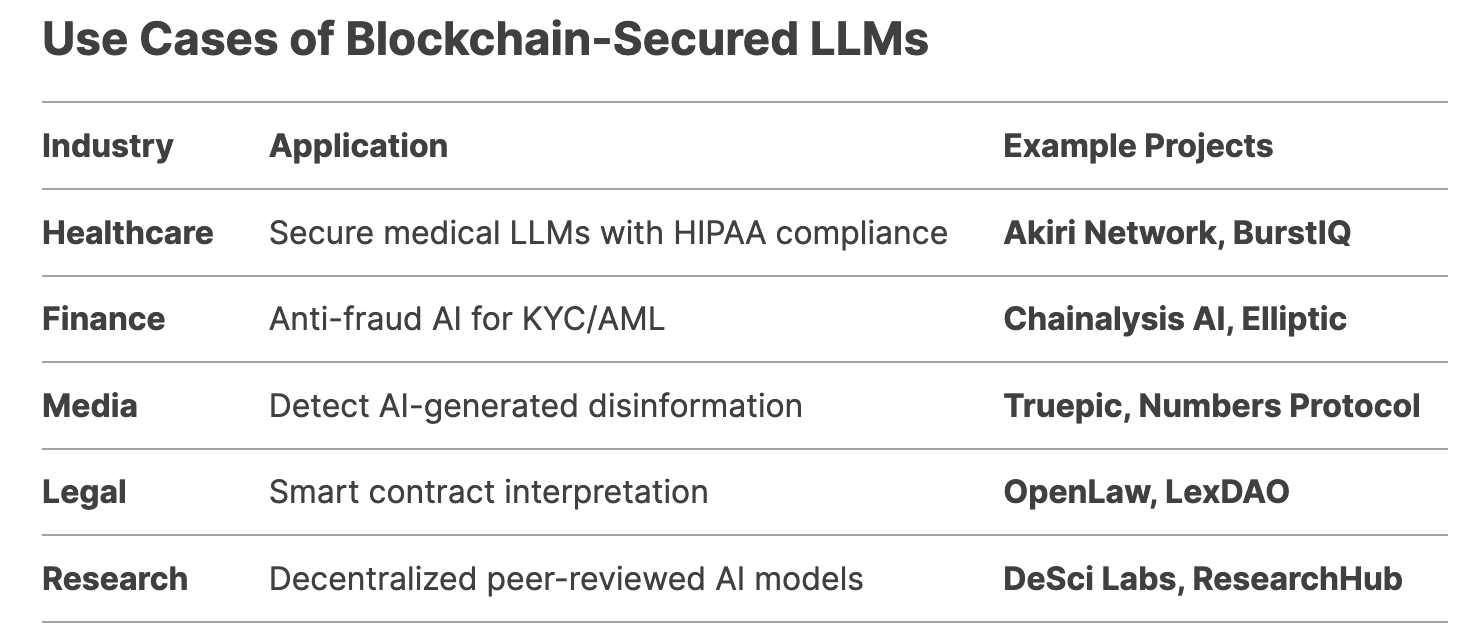
Use Cases of Blockchain-Secured LLMs
Case Study: Bittensor (TAO) – Decentralized AI Network
- A blockchain where miners contribute computational power to train open-source LLMs.
- Rewards: Miners earn TAO tokens based on model accuracy.
- Impact: Eliminates single-point control, enabling community-governed AI.
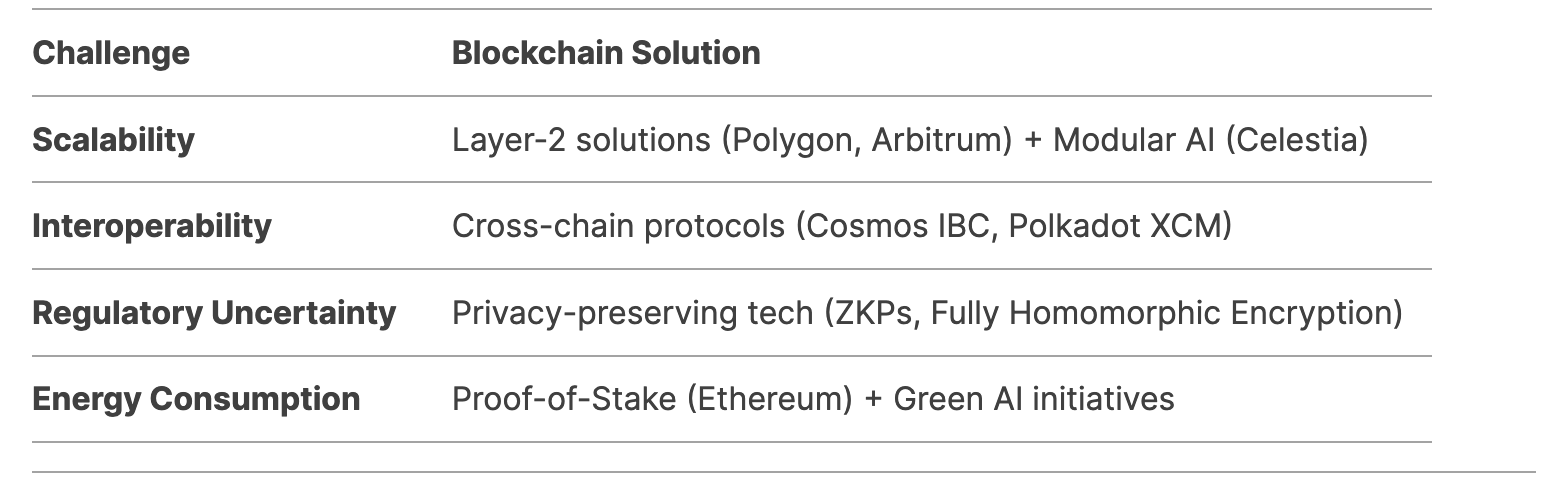
Challenges & Solutions
Future Outlook: The Rise of Decentralized AI
2025-2026
Wider adoption of hybrid AI-blockchain models (e.g., OpenAI exploring decentralized governance).
2027-2030
Self-sovereign AI agents that operate autonomously via smart contracts.
Long-Term
AI DAOs where stakeholders vote on model behavior, ensuring alignment with human values.
Conclusion
Blockchain-secured LLMs represent the next evolution of AI—transparent, tamper-proof, and democratized. By decentralizing control, enabling auditable training, and empowering users, this fusion of technologies can restore trust in AI systems.
Key Takeaways
Decentralization prevents single-entity control over AI.
Immutability ensures model integrity and data provenance.
Transparency allows public auditing of AI behavior.
User Ownership lets individuals monetize their data.
The future of AI is not just smarter—it's fairer, safer, and more accountable.