
Agentic AI and Generative AI: A Detailed Comparison
Agentic AI and Generative AI are two pivotal branches of artificial intelligence, each serving distinct roles in the technological landscape.
Understanding their differences is essential for leveraging their unique capabilities effectively. This comprehensive guide explores their characteristics, applications, and how they work together to transform industries.
Introduction
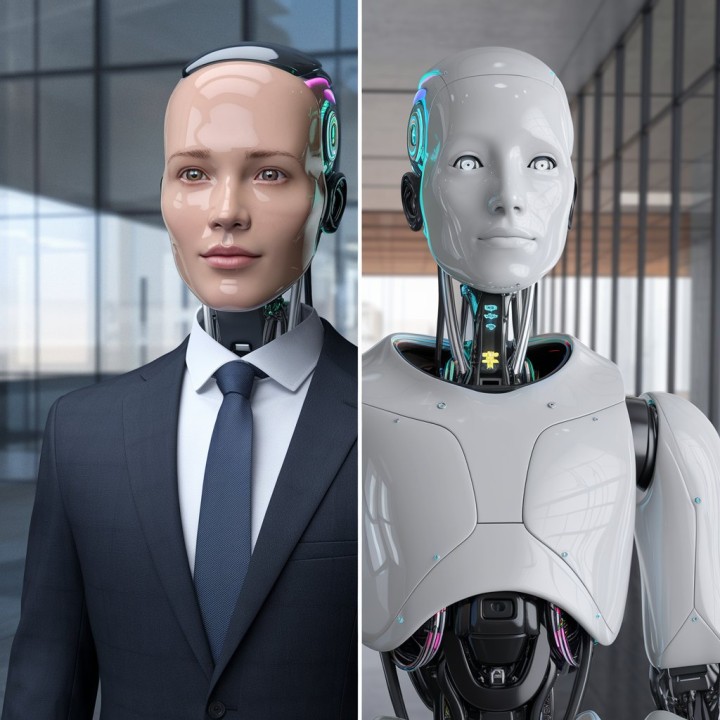
Agentic AI and Generative AI are two pivotal branches of artificial intelligence, each serving distinct roles in the technological landscape. Understanding their differences is essential for leveraging their unique capabilities effectively.
Generative AI
Generative AI refers to systems that can generate new content, such as text, images, music, or even code, based on the data they have been trained on. These systems use models like Generative Adversarial Networks (GANs), Variational Autoencoders (VAEs), or large language models (e.g., GPT, Bard) to create outputs that mimic human-like creativity.
Key Features
- Content Creation: Generates text, images, code, and more. (e.g., ChatGPT, GPT-4)
- Data Analysis: Identifies patterns and trends in large datasets.
- Adaptability: Adjusts outputs based on user feedback.
- Personalization: Tailors content to individual preferences (e.g., marketing, retail).
- Image generation (e.g., DALL·E, MidJourney)
- Music composition (e.g., OpenAI's MuseNet)
- Video synthesis
Generative AI focuses on creating new data that resembles the training data but is not explicitly programmed to perform specific tasks beyond generation.
Agentic AI
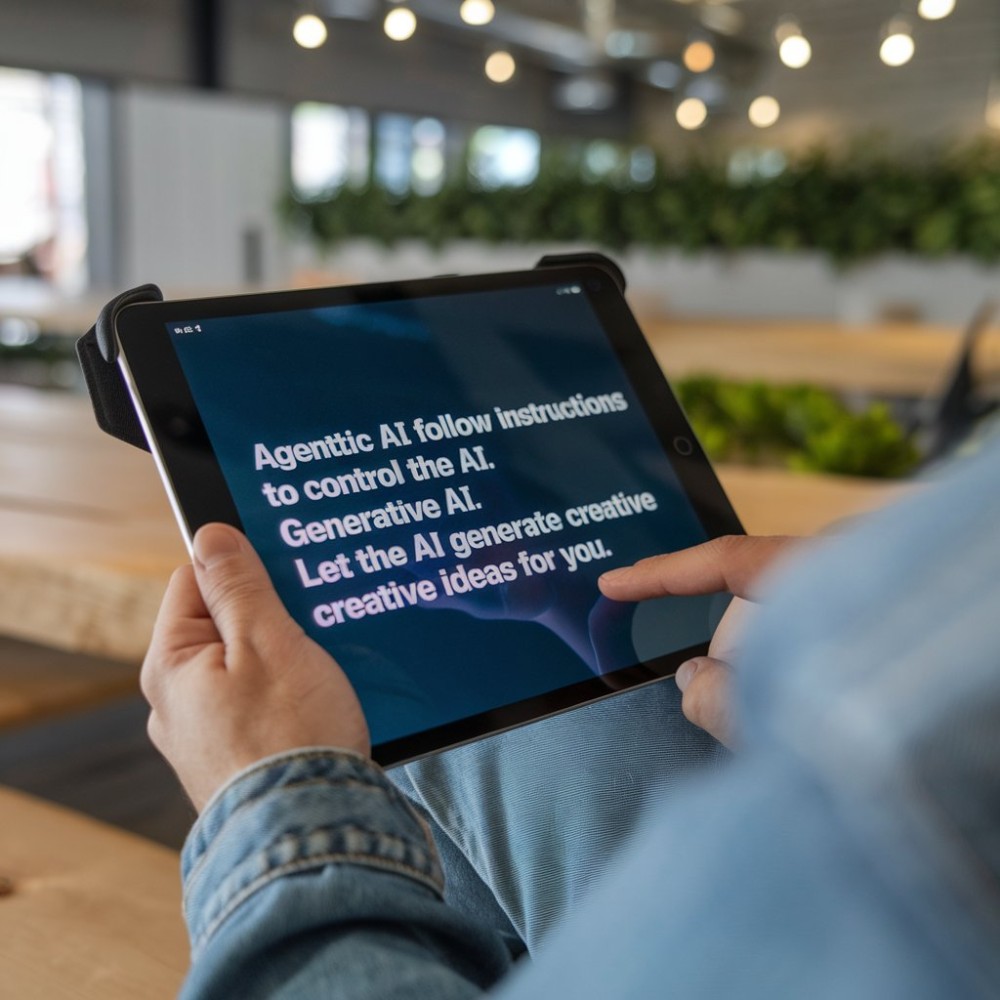
Agentic AI refers to AI systems that act as autonomous agents, capable of perceiving their environment, making decisions, and taking actions to achieve specific goals. These systems are often designed to operate independently or with minimal human intervention.
Key Characteristics
- Autonomy: Ability to operate without constant human oversight.
- Decision-Making: Assesses situations and determines actions autonomously.
- Problem-Solving: Uses a four-step process: perceive, reason, act, and learn.
- Goal-oriented behavior: Designed to achieve specific objectives.
- Planning: Executes multi-step strategies to achieve complex goals.
- Adaptability: Can learn and adjust strategies based on feedback or changing environments.
- Interaction: Can interact with users, systems, or environments in real-time.
Examples of Agentic AI include:
- Autonomous robots (e.g., self-driving cars, delivery drones)
- Virtual assistants that perform tasks (e.g., scheduling, booking)
- AI agents in gaming (e.g., NPCs with advanced decision-making)
- AI systems that manage complex workflows (e.g., supply chain optimization)
Agentic AI often incorporates generative AI as a component (e.g., generating responses or plans), but its primary focus is on action and decision-making rather than just content creation.
Key Differences between Generative AI and Agentic AI
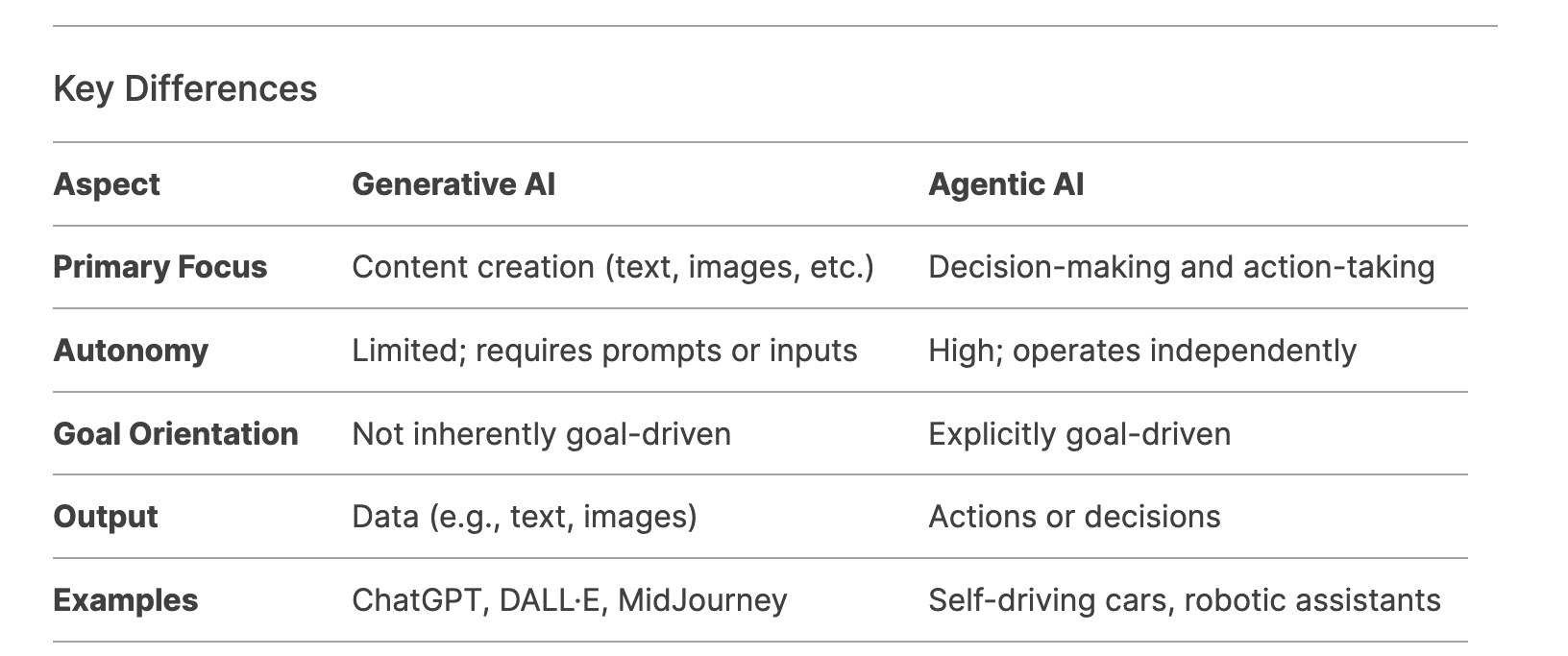
- Primary Focus: Generative AI is centered on content creation, while Agentic AI emphasizes decision-making and action execution.
- Autonomy: Generative AI typically requires user prompts to generate content; Agentic AI operates autonomously, initiating actions based on environmental inputs.
- Goal Orientation: Generative AI is not inherently goal-driven beyond content generation; Agentic AI is explicitly designed to achieve specific objectives.
Overlap and Integration
While generative AI and agentic AI serve different purposes, they can complement each other. For example:
- A generative AI model might create a plan or strategy, which an agentic AI system then executes.
- An agentic AI might use generative AI to communicate with users or generate reports.
In summary, generative AI is about creating content, while agentic AI is about taking actions to achieve goals. Both are transformative technologies with unique applications and potential for synergy.
Real-World Use Cases and Examples
Generative AI Use Cases
Content Creation
SEO-optimized blogs, marketing materials, and product designs. Companies utilize generative AI to craft personalized marketing content. For instance, tools like OpenAI's GPT-4 can generate tailored email campaigns, enhancing customer engagement.
Design and Fashion
Fashion designers employ generative AI to create innovative designs. IBM's Watson, for example, collaborated with Marchesa to design a cognitive dress, showcasing AI's role in fashion innovation.
Customer Support
Chatbots for handling inquiries and troubleshooting.
Product Development
Generating new product concepts based on market trends.
Personalization
Tailoring recommendations and experiences in retail.
Agentic AI Use Cases
Customer Service Automation
Businesses implement agentic AI to automate customer support. Moveworks provides AI solutions that autonomously resolve IT support issues, improving response times and efficiency.
Supply Chain Management
Agentic AI systems optimize supply chain operations by autonomously managing inventory and logistics, leading to cost reductions and improved efficiency.
Healthcare
Smart devices (e.g., inhalers) that monitor patients and alert providers.
Workflow Management
Automating supply chain operations and logistics.
Financial Risk Management
Analyzing market trends and making investment decisions.
Robotics
Autonomous robots in warehouses and manufacturing.
Emerging Trends
Generative AI Trends
- Augmented Applications: Integration into software for personalized user experiences.
- Synthetic Data: Using AI-generated data to train models in industries like robotics and finance.
- Deepfake Technology: Raising ethical concerns about misinformation.
- Content Personalization: Enhancing marketing campaigns with tailored content.
Agentic AI Trends
- Financial Services: Revolutionizing trading strategies and real-time decision-making.
- Robotics: Streamlining warehouse automation and manufacturing processes.
- City Planning: Analyzing datasets for urban development and traffic management.
- Human Resources: Automating routine tasks and providing dynamic employee support.
Case Studies
Octopus Energy's Use of AI
Octopus Energy integrates AI tools to enhance customer service operations. By employing AI-generated summaries and response drafting assistance, they streamline processes and improve customer interactions.
Synthesia's AI-Generated Videos
Synthesia utilizes generative AI to create instructional videos, enabling businesses to produce content efficiently without traditional filming.
Synergy Between Generative and Agentic AI
While generative AI and agentic AI serve different purposes, they can work together to enhance capabilities:
Generative AI can create plans, strategies, or content that agentic AI executes or uses in decision-making.
For example, a generative AI model might draft a response for a customer service chatbot, while an agentic AI system autonomously delivers it and resolves the issue.
Conclusion
In summary, while Generative AI and Agentic AI serve different functions—content creation and autonomous decision-making, respectively—they often complement each other in practical applications. Understanding their distinct and combined potentials allows organizations to harness AI technologies more effectively.
Generative AI is transformative for creativity and content generation, enabling businesses to produce personalized, high-quality outputs at scale.
Agentic AI takes autonomy to the next level, enabling systems to make decisions, solve problems, and act independently in complex environments.
Both technologies are driving innovation across industries, and their integration will likely lead to even more advanced AI applications in the future. Understanding their differences and complementary strengths is key to leveraging their full potential.